How does DOFE help young people find their own path, stay focused on their goals and turn their skills into a way of helping others? And why does every koruna invested in the programme yield a return of almost ten times the amount invested? Gabriela Drastichová, Director of DOFE in the Czech Republic, discussed this in the ‘Podnikavost Naostro’ podcast with Anna Kačabová from the ‘Podnikavé Česko’ Association.
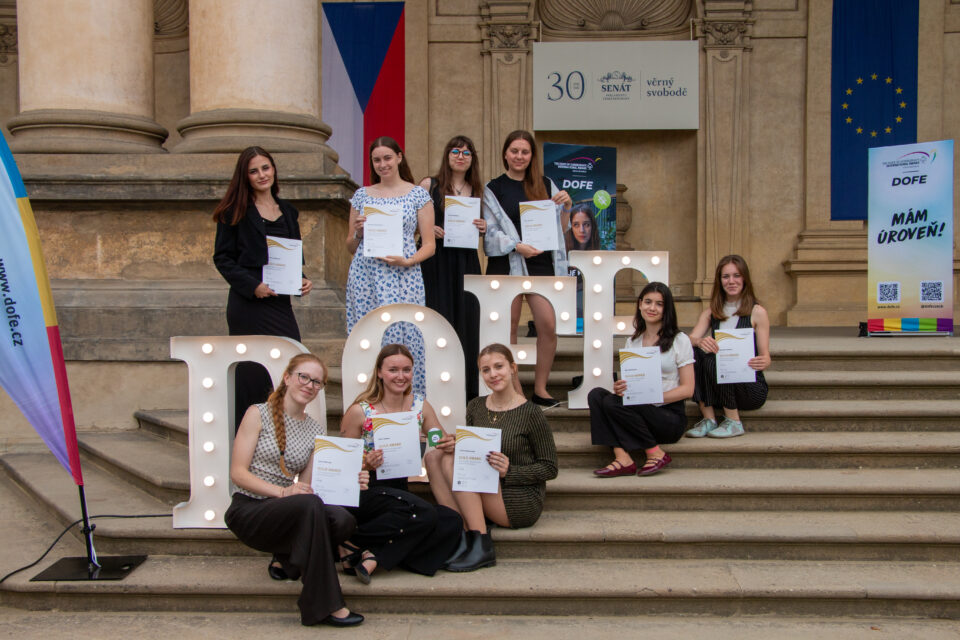
DOFE, or the Duke of Edinburgh’s International Award, is a non-formal education programme for young people aged 13 to 24. Participants set their own goals in the areas of physical activity, skills development and volunteering. The programme also includes a team expedition, and at the highest gold level, participants undertake a residential project.
It is not simply a matter of completing a few tasks and obtaining an international certificate. Young people learn to decide what they want to focus on, to plan their path and to persevere even when results are not immediately apparent.
„Just because I can’t do something doesn’t mean it’s not for me, but that I can learn to do it,“ Gabriela Drastichová says in an interview.
Opportunities must not only be recognised, but also seized
Gabriela Drastichová combines her own entrepreneurial spirit with the experience she gained at secondary school. She was surrounded by an environment that offered her opportunities and supported her in setting up her own student business, organising theatre performances and taking part in voluntary work.
„I was the sort of child who didn’t throw my gloves down for someone else to pick them up. I was the one who picked them up,“ she recalls. It was precisely this opportunity – the chance to seize the moment and make the most of it – that, in her view, also shaped her subsequent career path.
The same principle underpins the DOFE programme. Participants are not given a standard set of tasks that they must complete in the same way as everyone else. They choose for themselves what they want to learn, in which areas they want to develop, and whom they want to help. However, whilst they enjoy this independence, they are not left to their own devices. They are supported by a mentor who helps with planning, reflection and overcoming difficult moments.
Almost nine thousand young people and 85,000 hours of volunteering
In 2025, 8,999 young people took part in the programme. At the same time, the young volunteers contributed approximately 85,000 hours of voluntary work. They helped elderly people, walked dogs at animal shelters, collected litter, tutored younger pupils, and led Scout and hiking groups.
Gabriela Drastichová considers volunteering to be one of the programme’s greatest strengths. Its value often only becomes apparent over time. Some participants join DOFE for the certificate or the experience they can use in the admissions process. During the programme, however, they come to realise what the activity itself brings them and what value they create for those around them.
„A certificate is a nice way to mark success, but the value of the learning experience is what the young people actually came there for,“ explains Gabriela Drastichová.
In an interview, Anna Kačabová points out that this is precisely where volunteering meets entrepreneurship: „You’re developing the habit of seeing it as normal to contribute your work and skills for the benefit of the community.“
A mentor is sometimes more than just a programme guide
Young people are currently supported by more than 700 trained teachers and other youth workers. According to Gabriela Drastichová, around 96 per cent of these mentors devote their free time to the young people. It is not merely a matter of checking that activities have been completed. What is essential is the relationship between the young person and the adult, who offers them a safe space in which to share their thoughts.
In the podcast, she explains this role through the story of Alex, a Ukrainian secondary school student in South Bohemia whom she mentors herself via DOFE Online. Alex lives in the Czech Republic without his family and originally joined the programme partly because he is preparing to study abroad. He manages the individual activities independently, but has found the greatest value in volunteering and in regular contact with his mentor.
„DOFE can be as colourful as the people who come together there. I don’t have to lead its activities, but I can be an older friend to it and someone it can count on here in the Czech Republic,“ Gabriela Drastichová explains.
A programme for those who don’t stand out in class too
DOFE currently operates in around 450 schools and also offers the option of remote participation. Its further ambition is to expand its reach to vocational schools, apprenticeship centres, primary schools and smaller towns and regions.
Gabriela Drastichová also rejects the idea that this is a programme intended solely for successful students at prestigious universities.
„DOFE helps identify children who don’t stand out in mainstream classes. They might be sitting at the back of the class and struggle with maths, but they could be brilliant at something completely different.“
The programme can therefore help schools to identify abilities that do not come to the fore during normal lessons. It creates a space for young people to make decisions, try new things, learn from their mistakes and discover their own strengths.
An experience that will only become apparent in the years to come
DOFE also monitors the programme’s long-term social impact. According to its research, 96% participants view new challenges as an opportunity for personal development. Every koruna invested in the programme yields a social return of approximately 9.60 korunas. This figure reflects, for example, the impacts on physical and mental health, employability, relationships and the willingness to help others.
However, according to Gabriela Drastichová, the benefits of such education cannot be reaped immediately. They will only become fully apparent once young people enter the labour market, start families or begin to actively influence their communities.
The interview therefore also raises the question of whether schools and employers are able to recognise the value of experience gained outside the classroom. A DOFE graduate has more than just a certificate to show for it. They have experience of working towards a long-term goal, volunteering, collaborating, overcoming obstacles and taking responsibility for their own decisions.
As Gabriela Drastichová sums up: „When I do things for myself, they’re great. When I do them for others as well, they’re the best.“
How do making their own choices, the support of a mentor and experience of volunteering help young people? Listen to the full interview between Anna Kačabová and Gabriela Drastichová on the ‘Podnikavost Naostro’ podcast.
source: Enterprising Czech Republic Association